
Starfish Making a Comeback
Bright Colors and Bright News for the Ocean

This report is a bit short because I am two days into a migraine that is kicking my butt a bit. Even with that through, I wanted to share these encouraging developments I learned about last weekend.
My biggest Valentine’s gift to my partner, John, was a “no dog” weekend. He loves Olive and Micki and is super sweet with them, but two Border Collies are a lot and every so often I make sure John gets a break. I’d been craving an ocean trip for over a year so we headed to Lincoln City, Oregon.
Over the past couple decades, visiting the ocean has been a bitter sweet experience. In my youth, my family made annual trips to Neah Bay, on the Makah Indian reservation, in far northwest Washington State. The tide pools enchanted me, filled with bright purple and orange sea stars (AKA starfish), green anemones, crabs, fishes, mussels, scallops, and more. I would walk the marina docks with no interest in the boats, but fascinated by the countless species of rockfish, anemone, starfish on and among the pilings and the sea birds and seals looking for a meal.
Now, it’s unusual to find a rich and diverse tide pool on beaches in the Pacific Northwest. Overfishing, pollution, industrial sprawl, and climate change have diminished life at the shore. Starfish (Sea Stars) have disappeared. In 2013, sea star wasting disease was identified as the culprit. Sea stars are a chief predator of urchins, and their disappearance, coupled with the earlier eradication of sea otters, led to an explosion of sea urchins. Urchins eat kelp and their massive population increase decimated kelp forests along the coast. Kelp is a foundation species like trees in a forest and with the die-offs entire ecosystems were collapsing.
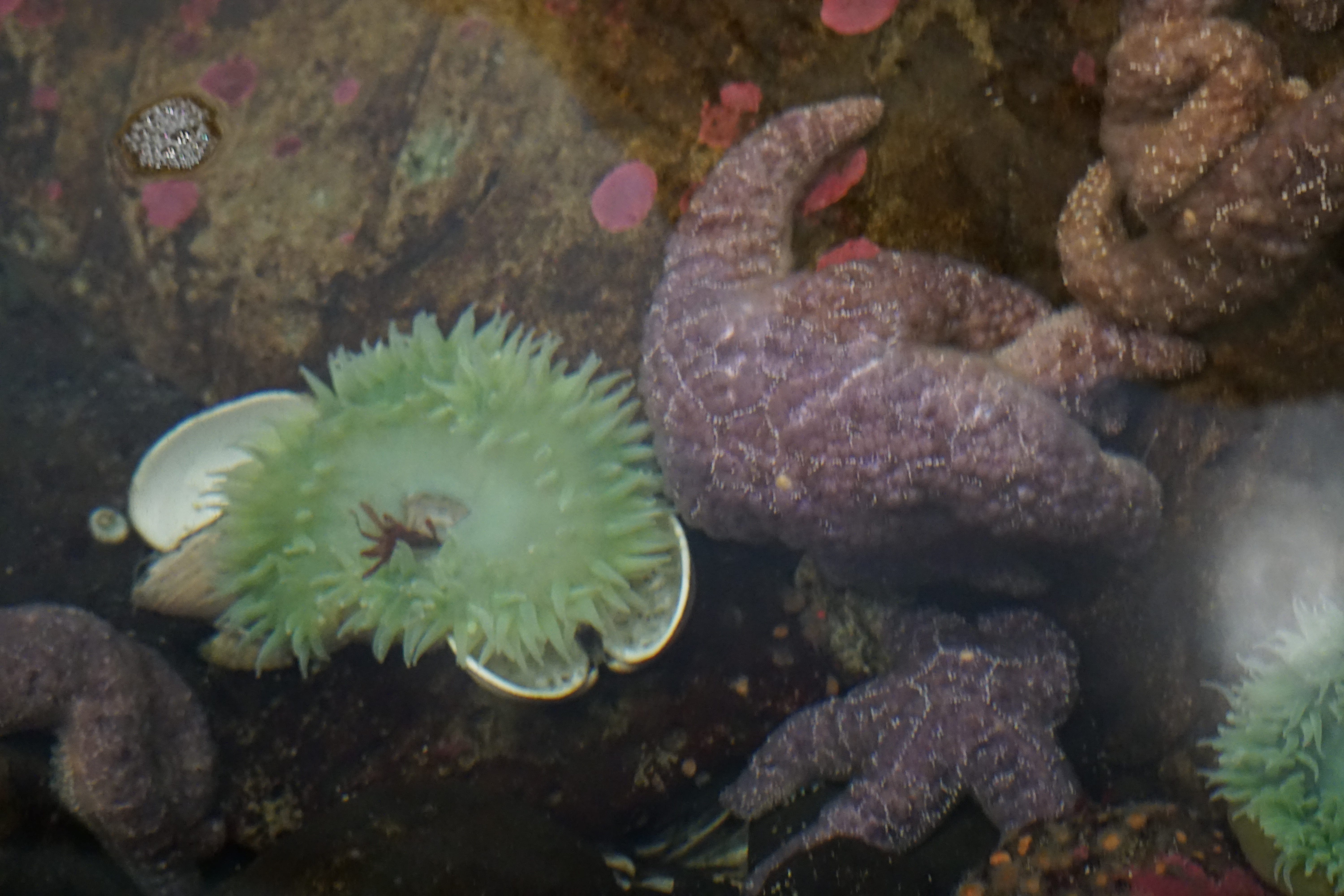
While on our unusually quiet, canine-free, coastal retreat, John and I visited the Oregon Coast Aquarium. I was overjoyed to see displays filled with orange, purple and tan starfish in many colors and configurations. I learned that just a year ago researchers discovered sea star wasting disease was bacterial, and efforts began to develop treatment options. Sea star populations are now beginning to rebound.
The Oregon Kelp Alliance (ORKA) is leading the effort to restore kelp forest ecosystems. ORKA, based out of Port Orford, on Oregon’s Southern Coast, represents diverse interests including commercial urchin divers, researchers, managers, conservationists, tribal members, tour guides, sport divers, chefs, and other community members in support of healthy kelp forests. The Elakha Alliance, another Oregon nonprofit organization is bringing together tribal leaders, conservationists, and nonprofit advocates to restore sea otter populations to the Oregon Coast.
I am so encouraged to learn that the rocky reefs off Oregon’s coast are still vibrant with color and movement, kelp forests are responding to protection, and sea stars may be coming back from the brink of extinction.
As for the migraine, both I and the girls are growing frustrated with my atypical slothfulness, but they are doing their best to be good nurses. Grateful for these girls and affirming speedy return of full health!
Here is Olive providing a well-intentioned tongue lashing.
And Micki offering sweet snuggles.
Thank you for being a subscriber to TRANSCEND. This research and writing is 100% reader-supported and I hope you find as much value in it as I do in bringing it to you. Please consider how you can support this work: refer a friend, make a one time donation to The ReThink Ministry, or upgrade to a paid subscriber where you get full access to all content and live conversations. Thank you!
You are such a love muffin